ChatGPT vs Google Gemini (2026): Pricing and How to Choose
The short version
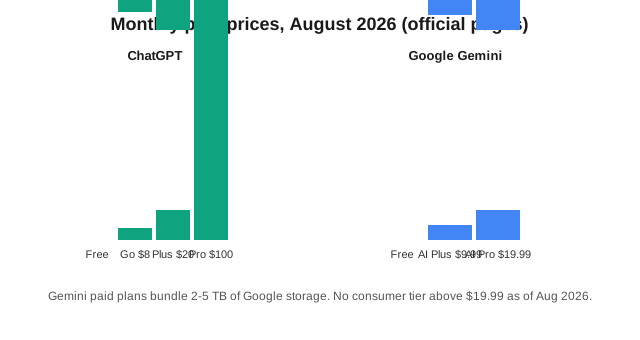
TL;DR: ChatGPT (Go $8, Plus $20, Pro $100) and Google Gemini (Google AI Plus $9.99, Google AI Pro $19.99) both have free tiers and roughly $10 and $20 paid tiers as of August 2026, but they are sold differently: ChatGPT is a standalone assistant subscription, while Gemini's paid plans are Google One storage plans that bundle Gemini access. Pick based on storage needs and workflow fit, not hype.Last updated: 2026-08-14. Prices and details verified against official sources.
This comparison is for professionals deciding between the two biggest AI assistants. Prices and model names below were verified on OpenAI's official pricing page and Google's official Google One and Gemini pages in August 2026. Model versions change every few months, so treat any model-specific claim as a snapshot.
How do ChatGPT and Gemini pricing compare in 2026?
Both companies offer a free tier and paid tiers around $10 and $20 per month. The structural difference is that OpenAI sells the assistant alone, while Google sells storage plans that include the assistant.
| Tier | ChatGPT (official pricing, Aug 2026) | Google Gemini (official Google One pricing, Aug 2026) |
|---|---|---|
| Free | $0 | $0 (15 GB storage) |
| Entry paid | Go - $8/month | Google AI Plus - $9.99/month (2 TB storage) |
| Mid tier | Plus - $20/month | Google AI Pro - $19.99/month (5 TB storage) |
| Premium | Pro - $100/month (GPT-5.6 Sol Pro) | No consumer tier above AI Pro as of Aug 2026 |
| Business | Business and Enterprise (per user/month, annual plans) | Workspace Starter $7, Standard $14, Plus $22 per user/month (Gemini included) |
Sources: OpenAI's pricing page, Google One plans page, and Google Workspace pricing page, all retrieved August 2026.
What models are current on each platform?
OpenAI's paid plans provide access to GPT-5.5, and the $100 ChatGPT Pro tier adds "Pro reasoning" with GPT-5.6 Sol Pro, per the official pricing page. Google's current flagship is Gemini 3 Pro, which appears on the official Gemini FAQ with a "Thinking with 3 Pro" mode, alongside earlier models like Gemini 2.5 and image and video tools including Veo 3.1. Both vendors ship new versions on a regular cadence, so flagship names will likely change within a year.
What do the paid tiers include?
ChatGPT Go ($8/month) sits between Free and Plus and is OpenAI's cheapest paid tier. ChatGPT Plus ($20/month) includes everything in Go plus projects, scheduled tasks, and custom GPTs, per the official pricing page. ChatGPT Pro ($100/month) adds the GPT-5.6 Sol Pro reasoning model and expanded usage.
Google's paid tiers bundle Gemini access with cloud storage. Google AI Plus ($9.99/month, 2 TB) includes the Gemini app with usage limits 2x higher than the free tier, plus access to the Flash Thinking model, Google Flow, Gemini in Gmail, and expanded Gemini Notebook access. Google AI Pro ($19.99/month, 5 TB) raises limits to 4x and adds the Pro model, Deep Research, Gemini in Docs and Vids, YouTube Premium Lite, and Google Home Premium, per the official plans page.
What is the key structural difference?
With ChatGPT, you pay for the assistant. With Gemini, you pay for Google One storage and the assistant comes with it. The $9.99 Google AI Plus plan buys 2 TB of Drive, Gmail, and Photos storage plus Gemini; the $19.99 AI Pro plan buys 5 TB plus higher Gemini limits and the Pro model. If you already pay for Google storage, upgrading to a Gemini plan may cost little or nothing extra in practice. If you do not use Google storage, you are paying for capacity you may never touch.
There is also no annual individual discount on ChatGPT's pricing page; Google lists annual billing with savings up to 16% on its plans page.
What about business plans?
ChatGPT offers Business and Enterprise plans priced per user per month with annual plans, per the official pricing page. Google's approach is different: every Google Workspace plan now includes the Gemini AI assistant, so businesses pay $7, $14, or $22 per user per month depending on tier (Starter, Standard, Plus), per the official Workspace pricing page. Businesses already on Workspace get Gemini without a separate add-on purchase, which can make Google's total cost lower for organizations that standardize on Google's stack.
How do you test both before paying?
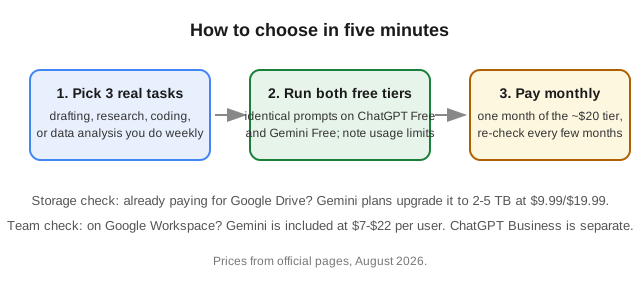
Both have free tiers, so the practical test is to run your own work through each before paying. Pick three tasks you actually do weekly (drafting, research, coding, data analysis, writing) and run identical prompts through ChatGPT Free and Gemini Free. Note where each hits usage limits, because limits differ by plan and change over time. If a free tier is not enough for your volume, pay for one month of the ~$20 tier rather than committing annually, then decide.
Which should you pick?
How do you decide in five minutes?
- Sign up for both free tiers and run your three most common real tasks through each.
- Check your storage: if you pay for Google Drive or Gmail storage, the Gemini plans upgrade it at the same price.
- Check your team: ChatGPT Business is per-user with annual plans; Workspace plans include Gemini at $7-$22 per user.
- Revisit the decision every few months - model releases shift the balance regularly.
FAQ
Is Gemini cheaper than ChatGPT?
At the entry level, no: ChatGPT Go costs $8/month versus Google AI Plus at $9.99/month. At the mid tier Gemini is marginally cheaper ($19.99 for Google AI Pro versus $20 for ChatGPT Plus) and bundles 2-5 TB of storage. ChatGPT's $100 Pro tier has no Google consumer equivalent as of August 2026.
Does Google Gemini have a free version?
Yes. Gemini has a free tier with 15 GB of Google storage, per the official Google One plans page. Paid plans raise Gemini usage limits 2x or 4x and add access to more models.
What is Google AI Plus vs Google AI Pro?
Google AI Plus ($9.99/month) includes 2 TB storage and Gemini with 2x usage limits and the Flash Thinking model. Google AI Pro ($19.99/month) includes 5 TB storage, 4x usage limits, the Pro model, Deep Research, and Gemini in Gmail, Docs, and Vids, per the official plans page.
What is ChatGPT Go?
ChatGPT Go is OpenAI's $8/month entry paid tier, positioned between the free tier and the $20/month Plus plan, per the official pricing page.
Which is better, ChatGPT or Gemini?
There is no stable, well-sourced answer: benchmark claims conflict and both vendors ship frequent updates. The verifiable differences as of August 2026 are price structure, storage bundling, and workflow fit.
Do the listed prices include taxes?
No. The prices on the official pages are base monthly prices; local sales taxes and VAT apply at checkout in most jurisdictions.